Who Owns the Stack: From Bitcoin to AI, the Race for Power Is Going Off-Grid
This article first appeared in The Energy Mag
In effect, Bitcoin companies are building the expertise to power the demand base for the technologies of the future, including AI.
Full Vertical Integration
For some operators, even taking ownership of power is not the final step.
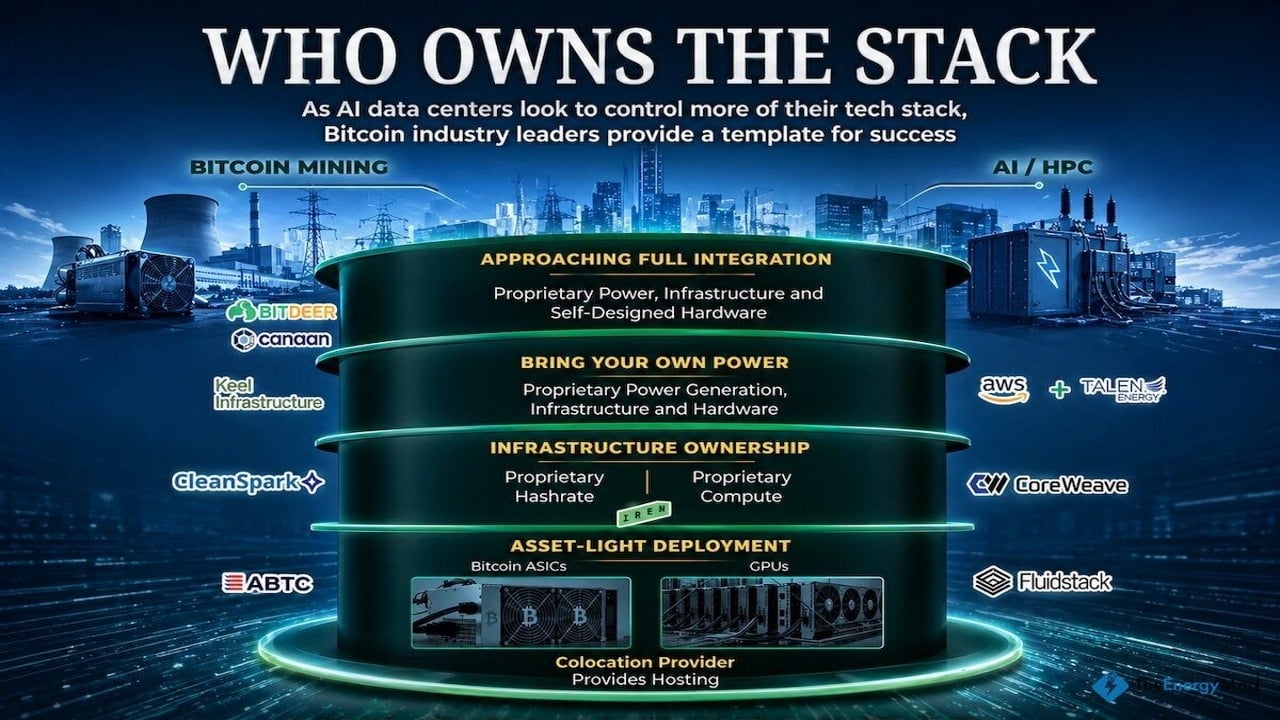
At the highest end of the spectrum, companies can control nearly every component of the compute system: power generation, infrastructure, hardware deployment, and even chip design.
In AI computing, hyperscalers (like Amazon Web Services, Microsoft and Google) are beginning to move in the same direction—developing custom chips, securing long-term energy supply, and building large-scale data center campuses tailored to their workloads. In Bitcoin mining, this model is no longer theoretical. It is already taking shape.
Canaan, the earliest Bitcoin ASIC designers with its Avalon brand, has expanded beyond hardware into operating its own mining infrastructure. In recent years, it has scaled proprietary computing power by deploying its own machines across sites it controls directly or through joint ventures. Earlier this year, Canaan deepened that strategy by acquiring Cipher Digital’s 49% stake in the Texas joint ventures with WindHQ, a wind electric power generator, moving its exposure further upstream in the stack.
A similar trajectory can be seen with Bitdeer. Originally focused on cloud mining and proprietary operations, the company has steadily expanded its control over infrastructure, scaling its exclusive computing power to around 70 EH/s. It has also moved into power generation, including the acquisition of land and a license for a 101 MW permitted plant in Canada, further integrating energy into its operating model.
At the same time, Bitdeer is extending horizontally into AI processing. The company has begun deploying its own GPU infrastructure for AI cloud services while exploring high-performance computing colocation opportunities with tenants.
This dual expansion—up the stack into power and across into AI workloads—illustrates how the boundaries between Bitcoin mining and data center infrastructure are beginning to dissolve. At this level, the objective is no longer just efficiency. It is access.
By operationalizing each layer of the stack, operators can optimize performance end-to-end, reduce exposure to external constraints, and define their own capacity limits.
While few companies fully occupy this position today, the direction of travel is clear. The closer operators move toward full integration, the more they transform from users of key energy and digital infrastructure into builders of it.
Same Stack, Different Positions
What emerges from this comparison is not a story of two separate industries, but of one shared system with multiple points of participation.
Bitcoin mining and AI data centers differ in their workloads and customers. But structurally, they operate along the same continuum of ownership—from asset-light deployment to infrastructure ownership, to securing power directly, and ultimately to full vertical integration.
More importantly, those positions are not fixed. Companies are constantly repositioning themselves—moving up the stack to gain control, or across it to capture new sources of consumer demand. These dynamics have strengthened the Bitcoin-AI coexistence approach: secure a sizable power contract and immediately monetize it with proprietary bitcoin mining power while seamlessly retrofitting the infrastructure for higher-margin AI computing colocation.
Bitcoin miners, by necessity, began solving these problems early, and AI companies are now arriving at the same conclusions. The key difference is no longer the system itself, but how each company chooses to navigate.
In the next installment, we will take this one step further: How these models are beginning to converge—and what that means for the future of energy, compute, and capital.
This article first appeared in The Energy Mag. The original article can be viewed here. The Energy Mag (formerly The Miner Mag) provides news, data, and insights on the energy–compute–markets nexus.
About Author